Time, easing, and motion algebra
Normalised segment time
An animated property changes over a segment \([t_0,t_0+D]\). KineticKit first normalises time,
then evaluates an easing function \(e(u)\), and finally asks the property's interpolator for the value at progress \(e(u)\).
Easing families
ease.linear is \(e(u)=u\). For \(n = 2, 3, 4, 5\) the names quad, cubic, quart and quint stand for the powers:
\(u^n\)
\(1-(1-u)^n\)
\(\tfrac12 (2u)^n\) for \(u < \tfrac12\), otherwise \(1 - \tfrac12 (2(1-u))^n\)
The sine family is in_sine \(= 1-\cos(\pi u/2)\), out_sine \(= \sin(\pi u/2)\) and in_out_sine \(= \tfrac12 (1-\cos \pi u)\). The exponential family is in_expo \(= (2^{10u}-1)/1023\), with out_expo and in_out_expo built from it the same way. Every function satisfies \(e(0)=0\) and \(e(1)=1\) exactly. The dictionary ease.STANDARD maps each name to its function.
ease.linear(u)
ease.in_quad(u), ease.out_quad(u), ease.in_out_quad(u)
ease.in_cubic(u), ease.out_cubic(u), ease.in_out_cubic(u)
ease.in_quart(u), ease.in_quint(u), ease.in_sine(u), ease.in_expo(u)
ease.cubic_bezier(x1, y1, x2, y2)
The easing namespace: the families above, cubic_bezier(x1, y1, x2, y2) for CSS-style timing curves, and STANDARD. Overshooting curves leave \([0,1]\) inside the segment, and the exact property values are still returned at the segment ends.
from kinetickit import ease

print(ease.out_cubic(0.5))  # 0.875
spring = ease.cubic_bezier(0.34, 1.56, 0.64, 1)
print(round(spring(0.5), 4))  # 1.0874, past the end value
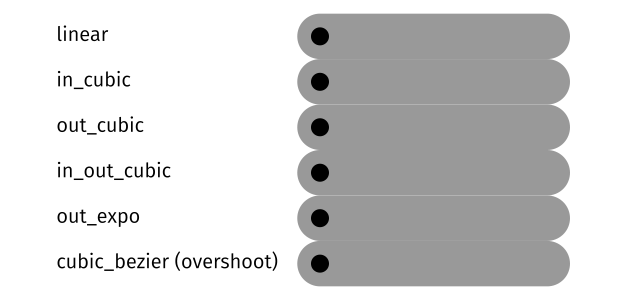
Six easing functions, each moving a point from one end of its track to the other in two seconds. The last curve overshoots.
Cubic Bézier timing
A cubic Bézier timing curve with controls \((x_1,y_1)\) and \((x_2,y_2)\) is
For a requested time \(u\), the easing value is the \(y\) coordinate whose \(x\) coordinate equals \(u\). The two \(x\) controls must lie in \([0,1]\), so \(x\) is monotone and the solution is unique; the \(y\) controls are free, which is how the last track above overshoots.
Composition
For a.then(b, gap=g), the duration is \(D_a+g+D_b\). For a.with_(b, offset=o) it is \(\max(D_a,o+D_b)\). Repetition multiplies the duration, reversal samples child time \(D-t\), and trimming maps a new interval back into the child interval. These operations build immutable motion trees before compilation.
forward = dot.animate.position.to(Vec2(9, 9), duration=1.0)
motion = forward.then(forward.reverse(), gap=0.4)  # D + 0.4 + D
The figure above is built this way: six motions run together with with_, then the whole motion is followed by its own reverse().
Keyframes and markers
A Keyframes motion lists values at times for one property. Each Keyframe can carry the easing for the interval that follows it, and hold=True keeps the value until the next keyframe. mark("name", at=0.0) names a moment on any motion, and interactions can seek to it (Accessibility and interaction).
from kinetickit import Keyframe, Keyframes, Point2D, Vec2, ease

p = Point2D(id="p", position=Vec2(0, 0))
fade = Keyframes(
    p.ref("opacity"),
    (Keyframe(0.0, 0.0), Keyframe(1.0, 1.0, easing=ease.out_quad), Keyframe(2.0, 0.2)),
)
print(fade.duration)  # 2.0