Outlines, subsets, and portable data
Glyph geometry
glyph = layout.lines[0].runs[0].glyphs[0]
outline = library.outline(glyph)
print(outline.units_per_em, outline.bounds, outline.commands[:3])
FontLibrary.outline(glyph) → GlyphOutlineA glyph from a layout. Its face and glyph id select the outline.
Returns the exact outline of a positioned glyph. It is in font units, so scale it by the run's size / outline.units_per_em and add the glyph's position.
GlyphOutline(glyph_id, commands, bounds, units_per_em, variation_coordinates=())An exact glyph outline: ordered path commands, bounds and the units per em.
MoveTo(point)Starts a new contour at the given point in font space.
LineTo(point)Adds a straight segment from the current point to its end point.
QuadraticTo(control, point)Adds a quadratic Bézier segment with one control point and one end point.
CubicTo(control1, control2, point)Adds a cubic Bézier segment with two control points and one end point.
Closes the current contour by connecting it to its start.
flatten(outline, *, tolerance) → tuple[Polyline, ...]Approximates curved commands with line segments at a tolerance that you choose, in font units.
Polyline(points, closed)One open or closed sequence of points returned by flattening.
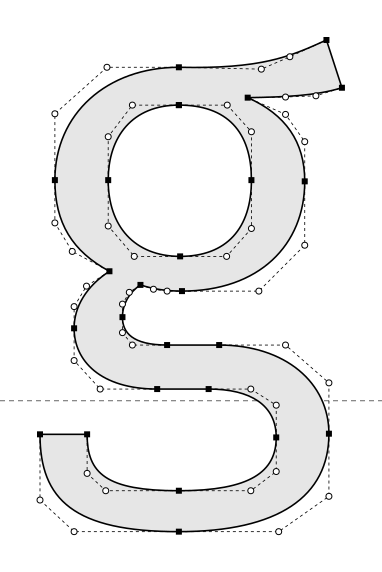
The exact outline of a glyph. Squares are on-curve points, circles are control points, and dashed lines are control polygons.
Permission-aware subsets
FontLibrary.subset(layout, *, embedding_use, container=..., allow_unknown=False) → FontSubsetBundleThe layout whose glyphs the subset must cover.
Why the subset will be embedded. The permission check depends on it.
The font container: SFNT or WOFF2.
Accept unknown permissions. The decision is recorded.
Builds a font subset that covers a layout, and returns bytes and metadata. It never writes markup or a file.
EmbeddingUse(*values)Declares why the subset will be embedded, so the font's permissions are enforced for that use.
FontContainer(*values)Chooses the container of the returned font: SFNT (OpenType) or WOFF2.
FontSubsetBundle(fonts, diagnostics=())The complete subsetting result: the portable fonts, diagnostics and metadata.
PortableFont(
    face_id,
    family,
    subset_tag,
    glyph_ids,
    permission,
    container,
    mime_type,
    data,
    variation_coordinates=(),
)
One permission-checked font payload with family, subset tag, glyph ids, permission and the bytes.
from glyphkit.embedding import EmbeddingUse, FontContainer

bundle = library.subset(layout, embedding_use=EmbeddingUse.WEB, container=FontContainer.WOFF2)
WOFF2 needs the portable extra. The permission rules are on the Reproducibility and font safety page.
Serialization
to_data(value) → dict[str, JSONValue]Converts a supported immutable public value into versioned plain data that is ready for JSON-like storage.
from_data(kind, data) → objectValidates versioned data and rebuilds the public value within the configured limits.