Stone-Geary
A generalisation of Cobb-Douglas that introduces subsistence quantities \(\bar{x}\) and \(\bar{y}\) — the minimum amounts of each good required before any utility is derived. The consumer first secures subsistence, then allocates the remaining supernumerary income like a Cobb-Douglas consumer.
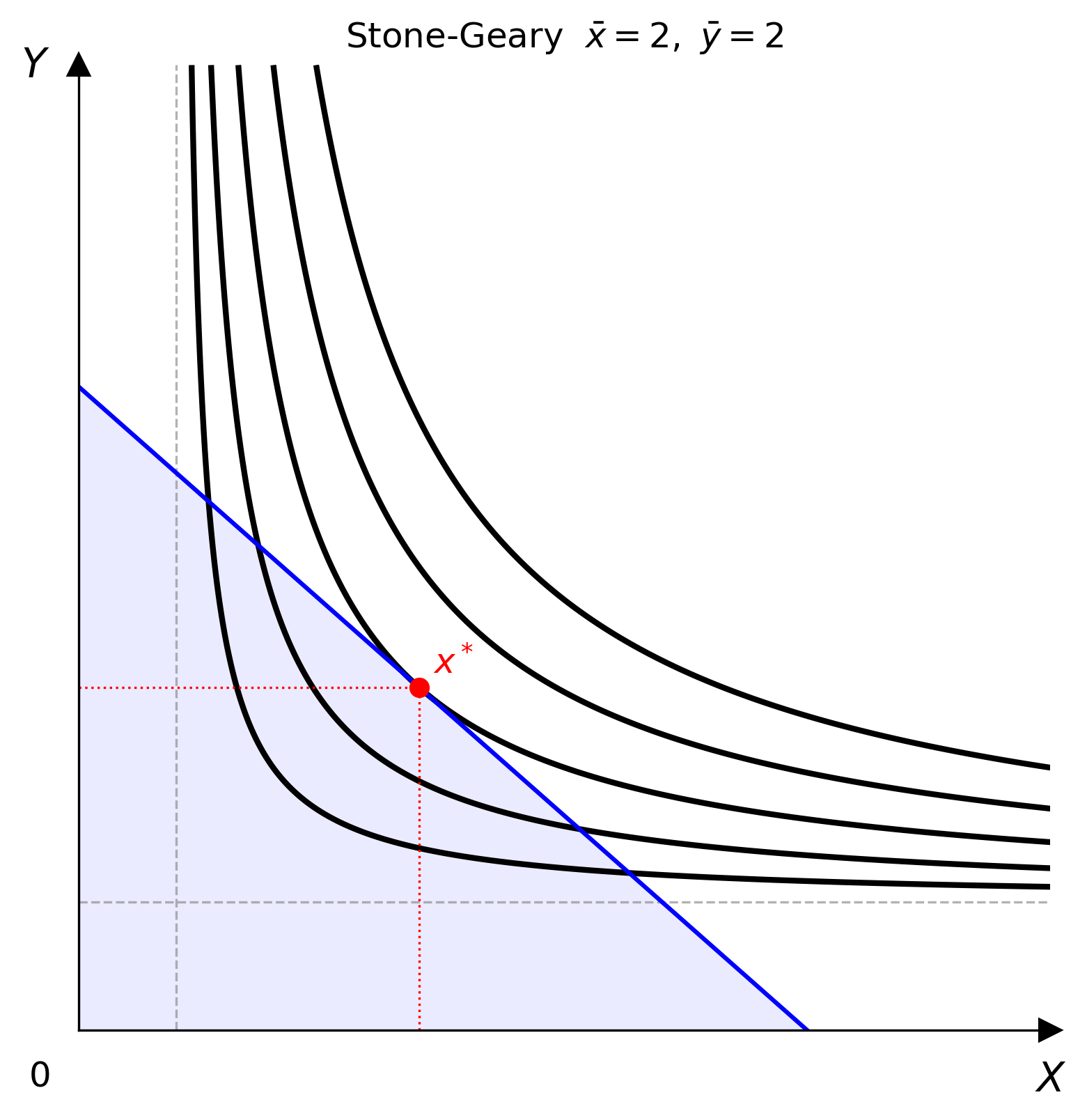
Utility is defined only in the supernumerary region \(x > \bar{x}\), \(y > \bar{y}\). Indifference curves have the same shape as Cobb-Douglas but are shifted away from the origin by \((\bar{x}, \bar{y})\). Dashed reference lines at \(x = \bar{x}\) and \(y = \bar{y}\) are drawn automatically on the canvas.
Parameters
| Parameter | Type | Default | Description |
|---|---|---|---|
alpha |
float | 0.5 | Expenditure share on supernumerary \(x\) (must be positive) |
beta |
float | 0.5 | Expenditure share on supernumerary \(y\) (must be positive) |
bar_x |
float | 1.0 | Subsistence quantity of good \(x\) (must be non-negative) |
bar_y |
float | 1.0 | Subsistence quantity of good \(y\) (must be non-negative) |
Optimisation
Let \(m = I - p_x \bar{x} - p_y \bar{y}\) be the supernumerary income — the budget remaining after securing subsistence. The consumer solves
Substituting \(\tilde{x} = x - \bar{x}\) and \(\tilde{y} = y - \bar{y}\), the problem reduces to
which is a standard Cobb-Douglas problem in the supernumerary quantities. The Marshallian demands are therefore
A necessary condition for an interior solution is \(m > 0\), i.e.
If this fails, solve() raises InvalidParameterError.
Relationship to Cobb-Douglas
Setting \(\bar{x} = \bar{y} = 0\) reduces Stone-Geary to Cobb-Douglas exactly. The expansion path for Stone-Geary does not pass through the origin — it is a ray from \((\bar{x}, \bar{y})\) — so no expansion-path ray is drawn on the canvas.
Usage
from econ_viz import Canvas, levels, solve
from econ_viz.models import StoneGeary

model = StoneGeary(alpha=0.5, beta=0.5, bar_x=2.0, bar_y=2.0)
eq    = solve(model, px=2.0, py=3.0, income=30.0)
lvls  = levels.around(eq.utility, n=5)

# Subsistence lines (dashed) are drawn automatically
Canvas(x_max=20, y_max=15, title=r"Stone-Geary  $\bar{x}=2,\ \bar{y}=2$") \
    .add_utility(model, levels=lvls) \
    .add_budget(2.0, 3.0, 30.0, fill=True) \
    .add_equilibrium(eq) \
    .save("stone_geary.png")
Note
StoneGeary is not yet available via the CLI. Use the Python API directly.
LaTeX parsing
Stone-Geary does not have a standard compact LaTeX form, so parse_latex() does not support it. Construct the model directly via the Python API.